

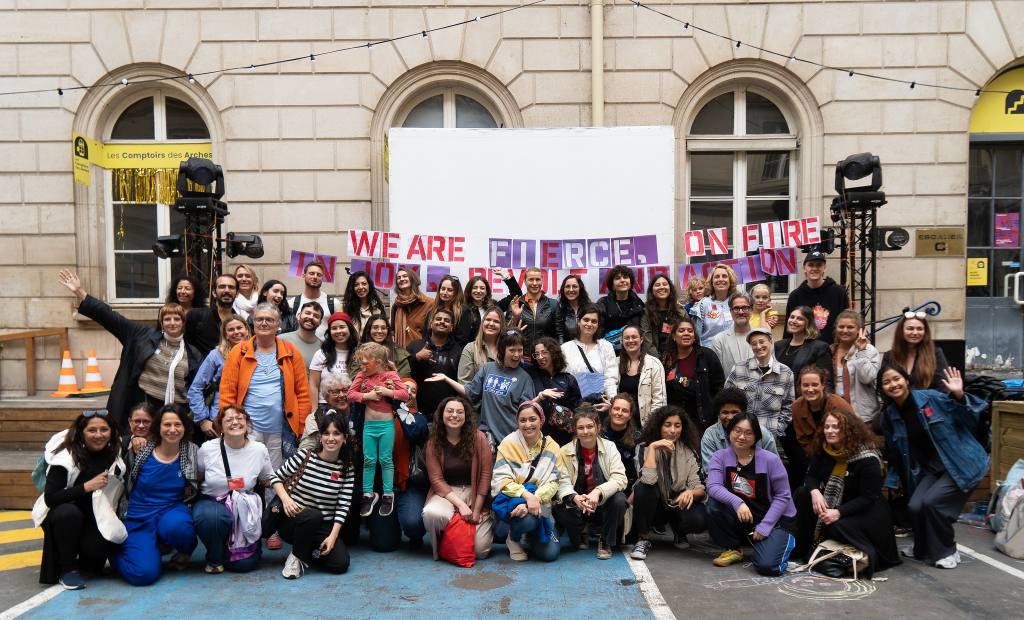
The event was a Citizens’ Assembly organised within the framework of the CitiDem project, under the overarching theme “Margins Are the New Centre”, with a specific focus on diversity and inclusivity. It was conceived as a space of democratic deliberation bringing together feminists, pro-democratic citizens and residents of the EU, parents from marginalised backgrounds, activists, researchers, artists, civil society organisations, and facilitators to collectively analyse how state structures and public administration shape unequal experiences of parenthood across Europe. The assembly was grounded in the idea that diversity and inclusion, while being universal fundamental values, are deeply differentiated by legal status, socio-economic position, gender identity, sexual orientation, disability, migration background, and family configuration, and that these differences are not accidental but produced and reinforced by institutional systems.
The event aimed to make visible how different groups – including transgender parents, rainbow families, families with disabilities, adoptees and wards of the state, refugee and migrant parents, single parents and families living in economic precarity – are exposed to similar forms of structural discrimination and administrative violence. By administrative violence, the assembly referred to the cumulative impact of bureaucratic procedures, legal frameworks, institutional practices and public service systems that systematically disadvantage certain groups and family structures, restrict their rights, or render their experiences invisible. The assembly created a collective space to connect these experiences and to show that they are not isolated or individual problems, but manifestations of a broader democratic deficit.
The programme started with a plenary introduction connecting the assembly to the wider Transeuropa programme, which included workshops on marginalised parenthoods, gender-based cyberviolence, verbal self-defence, unlearning racist and colonial structures, responses to anti-gender discourses, queer and political writing, and fighting sexist and sexual violence. This contextualisation emphasised that parenthood, gender justice, digital rights and anti-discrimination struggles are deeply interconnected.
A keynote thematic input, “Parentalités des Marges: défis et résilience”, set the tone by combining political analysis with lived experience. It highlighted how marginalised parents are often forced to navigate hostile legal environments, inconsistent recognition of family ties, discriminatory administrative practices and insufficient access to healthcare, childcare, housing and education. This moment helped anchor the assembly in both structural critique and embodied knowledge.
The core of the event was structured around participatory workshops, where participants were divided into thematic groups addressing four central dimensions of marginalised parenthood:
1. Economic insecurity and housing, examining how poverty, precarious employment and lack of affordable housing undermine family stability and access to rights.
2. Social stigma and discrimination, focusing on how LGBTQ+ families, transgender parents, disabled parents and racialised families face both institutional and social exclusion.
3. Access to services, analysing obstacles to healthcare, childcare, education and social support systems.
4. Legal and policy frameworks, addressing gaps and contradictions in family law, recognition of parenthood, custody rights and migration status.
Each group was facilitated by experienced moderators using a deliberative methodology that encouraged participants to move beyond a simple “top-down vs. bottom-up” approach. Instead, the assembly explored a third path in which local, regional, national and European levels of action are interconnected. Participants were invited to think strategically about how actions initiated at one level could scale to others and to nominate “ambassadors” and “governors” to embody these multi-level dynamics. This methodology reflected CitiDem’s ambition to bridge citizen deliberation with institutional change.
In addition to thematic analysis, the assembly incorporated transversal perspectives such as decoloniality, ecology, gender equality and intersectionality. Participants reflected on how adoption systems are historically linked to colonial legacies, how racialised families experience additional layers of exclusion, and how environmental and territorial inequalities intersect with social injustice in shaping
parenthood.
The event also explicitly connected the parenthoods theme to the broader findings of the Popular Assembly 2025, which addressed Health, Anti-Gender Movements, Media and Gender-Based Violence. Participants explored how:
● health inequalities affect reproductive and parental autonomy;
● anti-gender ideologies threaten the legal recognition of diverse families;
● media narratives shape public perception of “legitimate” families;
● and gender-based violence, including cyberviolence, undermines the safety and dignity of parents, particularly women and LGBTQ+ individuals.
The restitution phase allowed each group to present its conclusions and proposals in a plenary setting. This collective moment made visible the strong convergence between different experiences of marginalisation and reinforced the idea that diverse family configurations are affected by similar mechanisms of exclusion. The discussion then focused on prioritising recommendations and identifying pathways for political action, including legal advocacy, collective visibility strategies, transnational coordination and the creation of support infrastructures.
One of the most significant outcomes was the articulation of long-term visions, such as the idea of building a European legal support platform for families, inspired by models like the ACLU, to monitor cases, share jurisprudence, and provide coordinated assistance to families facing discrimination. Participants also stressed the importance of creating community-based action plans, policy briefs and
advocacy tools addressed to public authorities at different governance levels.
The assembly concluded with a synthesis highlighting that democracy must be lived in everyday institutional practices, not only defended rhetorically. Parenthood was framed as a powerful lens through which the failures and possibilities of European democracy become visible. By transforming lived experiences into collective analysis and political recommendations, the event embodied CitiDem’s core ambition: to strengthen democratic participation by reconnecting citizens, civil society and institutions.
Overall, the event functioned simultaneously as:
● a deliberative democratic space,
● a feminist and intersectional political intervention,
● a laboratory for rethinking public administration,
● and a platform for transnational solidarity between marginalised communities.
It demonstrated how citizen assemblies can serve as tools for making structural violence visible, reclaiming political agency, and co-creating pathways towards more inclusive, just and democratic European societies.
This project has received funding from the European Union’s CERV Programme. The content of this webpage and report reflect the author’s views and the Commission cannot be held responsible for any use which may be made of the information contained therein.