


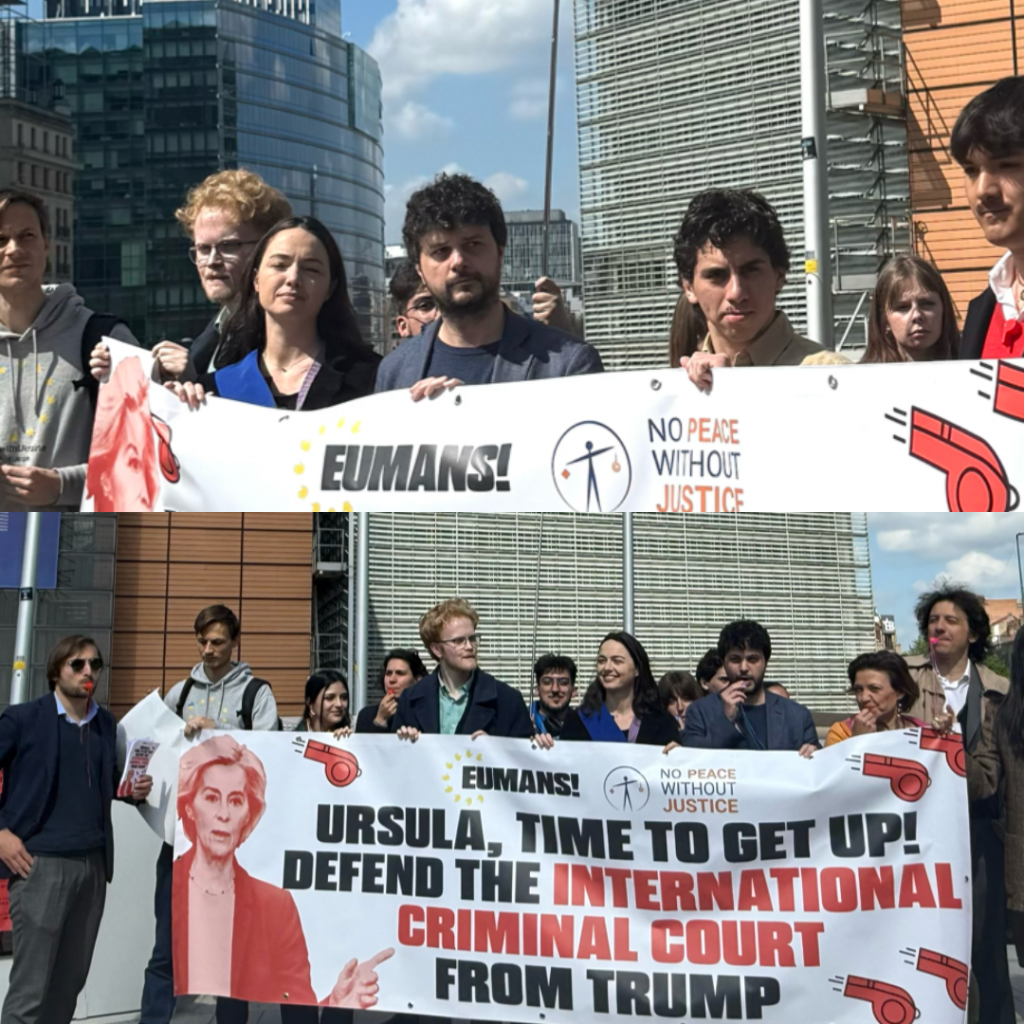
“To activate the blocking statute we don’t need a European army, we don’t need military power, we don’t need geostrategical influence, or money, we just need political will.”
This is what Marco Cappato, founder of Eumans, an organisation that is an active member of CTOE, stated in front of the European Commission on the 14th of April at the first sit-in of a political campaign demanding that the European Commission to immediately apply the EU Blocking Statute to protect the International Criminal Court from U.S. sanctions. Joined by MEPs, Citizens Take Over Europe, and other civil society organisations, Euman’s protest gained attention from curious bystanders and the media. The campaign also enjoys the support of four Nobel laureates.
This campaign calls on European institutions and citizens alike to resist political pressure and illegitimate sanctions that threaten the Court’s independence. Since February 2025, these concerns have intensified following the Executive Order 14203 issued by the United States, which imposed sanctions on ICC officials, including the Prosecutor, Deputy Prosecutors and several judges, as well as prominent Palestinian human rights organisations. These actions have raised significant concerns about the ability of the Court and its partners to operate freely. The campaign formally calls for the activation of the EU Blocking Statute and, in a gesture of significant symbolic weight, has submitted a bid for the International Criminal Court (ICC) to receive the 2026 Nobel Peace Prize, urging the EU to stand behind the ICC. The “Blocking Statute” is an EU law that prevents European companies from complying with extraterritorial sanctions imposed by countries outside Europe. The initiative aims to safeguard the ICC’s operations, ensure continued international cooperation, and protect those who support its mission from legal and financial risks.
Concretely, to pressure EU officials, the campaign consists of a series of “Satyagraha” actions (civil disobedience and relay fasting), as well as sit-ins, with Brussels being the first one, followed by protests in Bologna, Rome, Berlin, Madrid, and others. So far, 170 individuals have signed in to alternating hunger strikes.
The protest gained increased media attention with the presence of MEP Chloé Ridel (S&D, France), who delivered a speech emphasising that “without justice, there will be no truth for the crimes happening in Gaza and elsewhere in Palestine” and called for justice and truth as prerequisites for peace. She encouraged others to join the campaign. MEP Brando Benifei (S&D, Italy), from the European Parliament delegation to the US, noted that the sanctions are based on an executive order by US President Trump without Congressional approval, meaning no approved legislation, only a pending executive decision. He highlighted that the European Parliament has already supported the Blocking Statute, but the European Commission continues to ignore this, requiring continued pressure. He stressed that international law remains central to democracy and the European Union.
Despite the ICC being an institutional cornerstone for international justice, the court has been under international scrutiny over the past several years. For example, the African Union (AU) accuses the court of being overly strict against African nations and specifically targeting their leaders. The AU blames the ICC for issuing arrest warrants and taking legal action against African officials while choosing to let Western leaders who have committed similar acts walk free. These double standards between the West and the African continent have led countries like Burkina Faso, Mali, and Niger to withdraw from the court.
Currently, the court is involved in a dramatic controversy surrounding one of its top prosecutors. In 2024, Karim Khan was accused of sexually harassing two women who worked under him at the ICC. Three separate bodies ICC judges, the UN, and ICC Bureau all produced different conclusions in their investigations into the Khan controversy. And, Khan’s actions are not an isolated event. A report from 2021 found a ‘climate of fear’ with flagrant bullying and sexual harassment against employees within the ICC. An internal report by the court found reports of bullying had doubled in 2025.
These issues put the court’s legitimacy into question. Can we trust a court with an alleged neo-colonialist framework and culture of harassment to protect us? We must also question the efficacy of the court. Notably, of the 17 conflicts it has investigated in 23 years, the ICC has only prosecuted 9 war criminals.
EUMANS is a member of CTOE. If you would like to become a member too, click Join.