


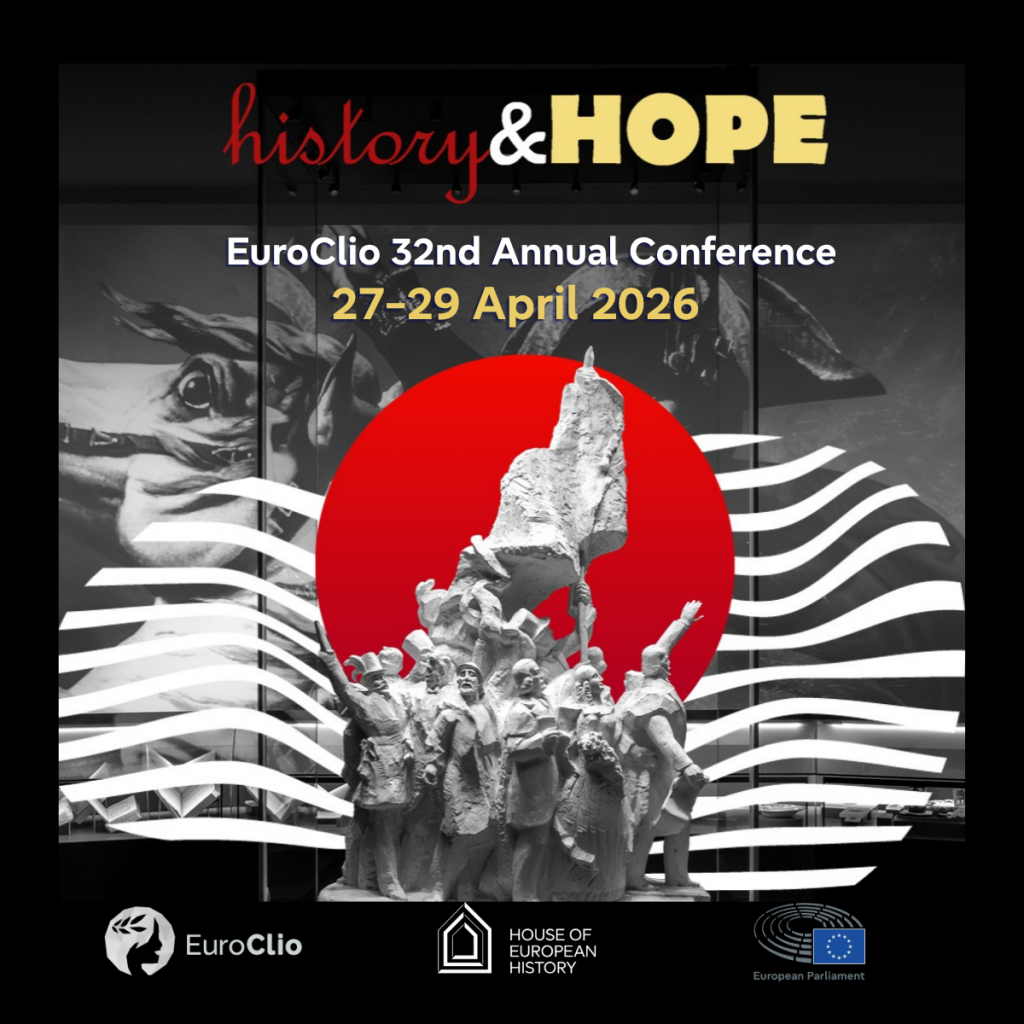
On April 27 2026, Citizens Take Over Europe joined approximately 250 history educators, teachers, and institutional partners at the 32nd EuroClio Annual Conference, History and Hope: Learning for Change, hosted in Brussels. The conference brought together participants from all over Europe to jointly create the Hope Manifesto: a teacher-led declaration stating that history education is essential to democratic life, and that how the past is taught cannot be separated from how the future is protected.
Across Europe, citizens feel increasingly distant from the decisions that shape their lives, and young people reach voting age without the appropriate tools to manage difficulties, evaluate opposing claims, or understand how the present history is the result of the choices of the past.
We attended the 32nd EuroClio Annual Conference 2026, History and Hope: Learning for Change. This year the theme was Hope and it is not a coincidence of timing. It is a response to the urgency of today’s challenges and conflicts. It brings together history educators from across Europe at a moment when the question of how we teach the past has become inseparable from the question of how we protect the future.
At the core of this gathering is the creation of the Hope Manifesto, a shared, teacher-led declaration formed by a participatory process involving around 250 history educators and shaped by voices from across Europe. It is not a policy document. What it offers is something different and more durable: a common point of reference for educators, institutions, and organisations working at the intersection of education, democracy, participation and civic engagement. It expresses hope not as simple optimism, but as a pedagogical orientation, a commitment to the belief that history education can help young people engage with the past, understand the present and imagine their own role in shaping the future.
Teachers are among the actors who have a significant part in shaping the young generations. They are the ones who sit with young people at the exact moment when political identities are forming. They are the ones who should provide plurality of perspectives, encourage and foster critical thinking and explain that the present is not inevitable, that it was made by people and it can be reshaped by people.
Nowadays, civic education in schools is not enough if it is reduced to a single lesson or cannot be just about a single vote. Civic education must be more developed and included and have its own space. In this way young people can have the necessary knowledge and tools to participate better in democratic decisions. This is especially important when we consider a new generation across Europe that is approaching the voting age, which every year has more issues that are crucial for all citizens. Debates about civic participation and democratic disengagement among young people cannot be addressed only by institutional reforms. The response must also be educational. Citizens are not born informed; they are shaped in classrooms by teachers who sometimes understand that their work extends far beyond just the mandatory syllabus. When history education is taught with plurality and purpose, it has the power to provide young generations not only with knowledge of the past but with the critical capabilities needed to participate meaningfully in the democratic life of today.
The Hope Manifesto is not a directive from above, but is a collective expression of those doing the work. It is a reminder that democracy is not only a system of governance. It is a practice, and it begins in schools.
We, as CTOE, align with EuroClio’s mission in ensuring educators, schools, cultural institutions and education policymakers across Europe get the proper support in ensuring that each history teachers can do their work with integrity and to recognise civic and history education not as peripheral subjects, but also as part of democratic life.