


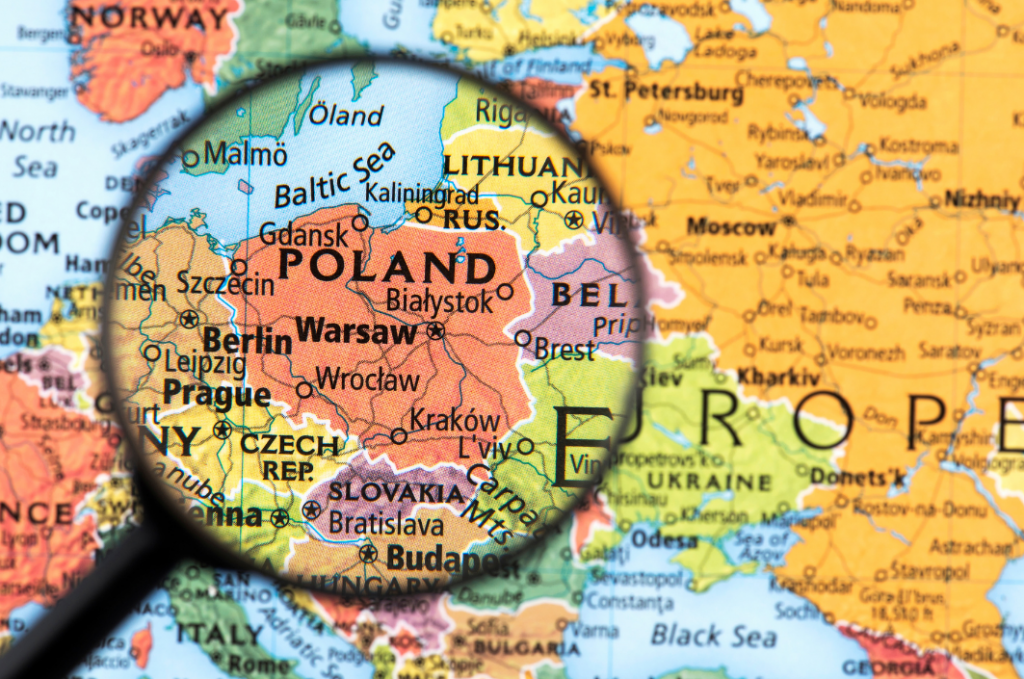
Poland is a democratic country that has a growing economy and no ethnic conflict, yet for over a decade, especially since 2005, when it started consolidating the two-party system, it has been slowly drifting apart. Two political forces, Law and Justice (PiS) and Civic Platform (PO), are dividing the country. The disagreement is not just about policy; it is over the very rules of democracy. No election has managed to solve this division because it is a structural division. Professor Maciej Kisilowski, through the proposal Let’s Agree on Poland, calls for a new constitutional settlement built on decentralisation and power-sharing.
Poland’s Political Divides
Poland has a democratic system; however, over the past decade, especially after the rise of Law and Justice (PiS), internal political conflict has risen. On one side, there is PiS, and on the other, Civic Platform (PO). PiS represents a conservative vision and PO represents a more liberal one.
The conflict is not only about the political parties or policy choices, but it is also about the rules of the political system, the balance of power between institutions, and the role of justice and the rule of law. Topics such as judicial reforms, media independence and constitutional norms have shown that the main political groups do not just disagree on policies, but they have different views on how democracy should function.
Poland’s main problem is that the political system is largely majoritarian, which means that the party that wins elections has strong control over democratic institutions, while the losing side has very limited power. This creates a scenario known as “winner-takes-all”. But the real problem here is not who wins the elections, but the fact that the system does not manage disagreement in an effective way. This becomes a huge problem when there is a polarised society, and institutions are designed to have one side that governs alone. In this way, large parts of the population are excluded from the democratic decisions.
The Roots of Polarisation
During a seminar titled “Let us agree on Poland: How to rebuild a divided nation” and hosted by Professor Paul Blokker (University of Bologna), Professor Maciej Kisilowski explained that Poland’s political division does not follow the classical explanatory variables. The usual causes of polarisation are poverty, economic decline or foreign interference. For Poland, these causes do not explain this political division because Poland actually experienced strong economic growth and low inequality in the decades following 1989, and it is not a deeply fragmented multi-ethnic society. The roots of the conflict are elsewhere. This polarisation is described as a conflict between two political movements: on one-hand a revolutionary conservative movement and a liberal anti-revolutionary one on the other. This division is deeply connected to Poland’s history and geography. Different regions of the country have different political identities and these differences are still strong today. In current debates regarding topics such as migration or LGBTQ+ rights, the division is evident. Conservative PiS tends to favour stricter border control and a more cautious approach to immigration, while PO is more open to European coordination and humanitarian migration policies. Regarding LGBTQ+ rights, there is an opposition from Law and Justice (PiS) to the expansion of LGBTQ+ rights.
Because of this cultural division, the political conflict is not just temporary and it cannot be solved easily.
The proposed solution
Let’s Agree on Poland proposes a response to this structural division: a new constitutional settlement built on a redesign of the political system through decentralisation, power-sharing and stronger local democratic authority. Rather than imposing a single national vision, the model would allow different regions and cities to function as separate ecosystems. Spaces where local majorities can rule based on their values without imposing on others. The main point is to move away from the “winner-takes-all” central state and more towards models such as City-States. This proposed solution would leave more space for local preferences. The proposal includes several reforms. A reformed Senate composed of regional leaders that would give territorial diversity a more solid voice at a national level. For city mayors, a role in judicial appointments involves them in judicial matters to ensure that the court system reflects local democratic mandates. The logic behind this is simple: if political conflict is inevitable, the solution is to modify institutions that should prevent one side from governing the entire state and imposing its vision on everyone else. Reinforcing local powers promotes a more bottom-up approach and reinforces citizens’ direct impact on policy reform.
Deliberative Democracy
Another topic of the seminar was focused on deliberative democracy. This approach is based on a simple idea of citizens who can talk to each other openly and rationally in order to find a common ground and overcome political divisions. This model is characterised by:
– Public discussion to reduce conflicts
– Legitimacy comes from the quality of the decision-making process
Deliberative democracy supports the idea that overcoming division is possible and societies can gradually find a common agreement with this model.
A Different Approach to Democracy
Professor Maciej Kisilowski presented an alternative to deliberative democracy. The alternative, referred to as the Institutional/Incubator model, takes a more sceptical view. It argues that the cultural divisions that are present in the political playground cannot be solved just through deliberative democracy. So, in Let’s Agree on Poland, the alternative way is focused on thinking about democracy through institutional pluralism. The main point is to redesign institutions that create separate spaces for different groups that have to coexist in the same ecosystem, and do not focus on agreement between them. Legitimacy, in this model, depends on the outcomes, which means that institutions are legitimate when different communities can recognise themselves in the results, even when there is no full agreement between citizens.
This shift of ideas leads to a broader reflection on what democratic governance should achieve in deeply divided societies.
Europe’s Shared Challenge
Poland’s case can go beyond its own borders. It is an example of a dilemma faced by many European democracies: how to have legitimacy in a divided society that is increasingly polarised and culturally divided. The strategic decentralisation can be a solution, but it does not address deep cultural divisions. Should it be addressed in this way, or is deliberative democracy still the best solution?
The wider democratic lesson here is that civic participation should go beyond voting every few years or attending representative consultations. True democratic participation requires institutions that empower citizens to profoundly influence public power even at the local level and hold it accountable over time.
For Citizens Take Over Europe, the key value is not uniformity but to have a voice in democratic decisions. Citizens should be able to be part of a democratic system without needing to remove others’ values or impose their own on the entire system.