



The 2026 parliamentary election in Hungary marks a turning point after 16 years of rule by Viktor Orbán. The victory of Péter Magyar and the Tisza movement, with an extraordinary turnout of around 78%, reflects strong citizen demand for democratic revival.
Hungary’s new parliament: projected seat distribution following Hungary’s 2026 general election, with 98.9 percent of the votes counted.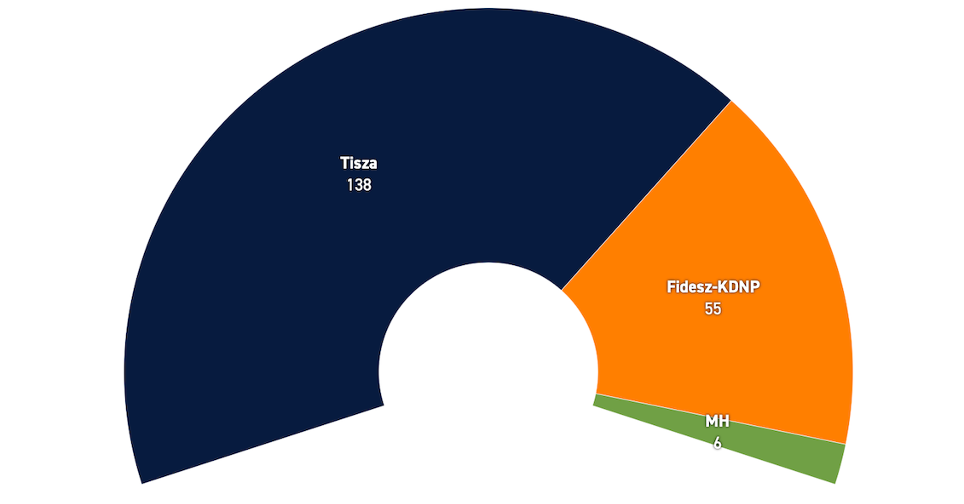
Source: POLITICO Poll of Polls — Hungarian polls, trends, and election news for Hungary (Data updated April 2026)
This victory presents a unique opportunity to dismantle the “illiberal” framework established since 2010. It opens up some potential opportunities:
– Rebuilding of democratic institutions: Peter Magyar plans to re-establish the independence of courts, prosecution, public media, and regulatory agencies. Rebuilding the independence of these bodies ensures that the government is once again subject to the law, not above it. When courts are independent, a citizen’s rights are protected regardless of their political affiliation. A free media provides voters with free information rather than curated propaganda, allowing them to hold their leaders accountable.
– Dismantle corruption and restore trust between citizens and the state: in the program of Tisza, there is a strong commitment to fight corruption and fix checks and balances, which is essential for regaining public trust in state institutions.
– Reengagement with the European Union: there is an effort to recreate relations with Brussels in order to unlock frozen EU funds and to improve the economic prospects of Hungary. Unlocking these funds offers crucial support for a struggling economy. A stable Forint and renewed foreign investment lead to lower inflation and increased purchasing power for households. This directly links democratic stability to individual economic well-being.
– Renewed political inclusion of marginalised groups: Roma voters significantly influenced the electoral result, demonstrating their potential as an organised and decisive political force. Their involvement presents a chance to progress towards more inclusive governance and tackle longstanding inequalities. Strengthening democratic institutions would also lead to improved political representation and social integration for marginalised communities. This, in turn, would reinforce the legitimacy of the new political order.
Generally speaking, this election is an example of how sustained civic participation can lead to a political change, even after long periods of well-established populist governments. But at the same time, this transition brings up some important potential risks and challenges:
– A deeply ingrained institutional legacy: after a long period of structural changes under Orbán, rebuilding independent institutions and making reforms will be slow and likely to face resistance from well-established power structures.
– Political polarisation: deep societal divisions can hinder cooperation and inclusive governance. Deep polarisation fosters social tension. This leaves the average person feeling like they’re in a “us vs them” battle during political debates. This hinders the national cooperation needed to tackle complex issues.
– External constraints: Hungary’s cautious position on Ukraine, including opposition to a rapid EU accession process (through a possible Hungarian referendum) and limited involvement in military support, could trigger potential tensions at the European level. Moreover, energy dependence and economic stagnation will limit the pace of internal change.
– Conservative limits on fundamental rights: While Tisza presents itself as a reformist power, it’s a centre-right conservative party and doesn’t necessarily suggest a progressive shift across all social issues. Its strategy focuses on broad electoral appeal rather than a clear commitment to expanding rights. For example, on abortion, the party seems to accept the current regulatory framework as a compromise. Concerning LGBTQ+ rights, it supports general principles, such as freedom of assembly, but hasn’t promised to revoke controversial legislation. It also takes a cautious approach to symbolic issues, such as limited engagement with Pride events.
For citizens and democracy, this election represents both an opportunity and a test. On one hand, a significant voter turnout and civic mobilisation suggest that after years of restricted democratic space, there was a strong comeback of citizens’ participation and commitment. On the other hand, there is a challenge of rebuilding a functioning democracy. A key issue is declining media freedom under Orbán that posed limits on access to independent information. In response to this issue, Tisza proposed a media system reform. This includes demolishing state propaganda, re-establishing independent public broadcasting, ensuring transparency, and supporting independent journalism. Protecting freedom of expression and providing access to independent information are crucial for empowering citizens’ civic participation because democracy depends not only on elections, but also on active and informed citizens who can properly be part of public life.
To uphold these values, CTOE will closely monitor ongoing developments and foster deep partnerships with Hungarian civil society to remain vigilant against any democratic backsliding or to support its potential revival.